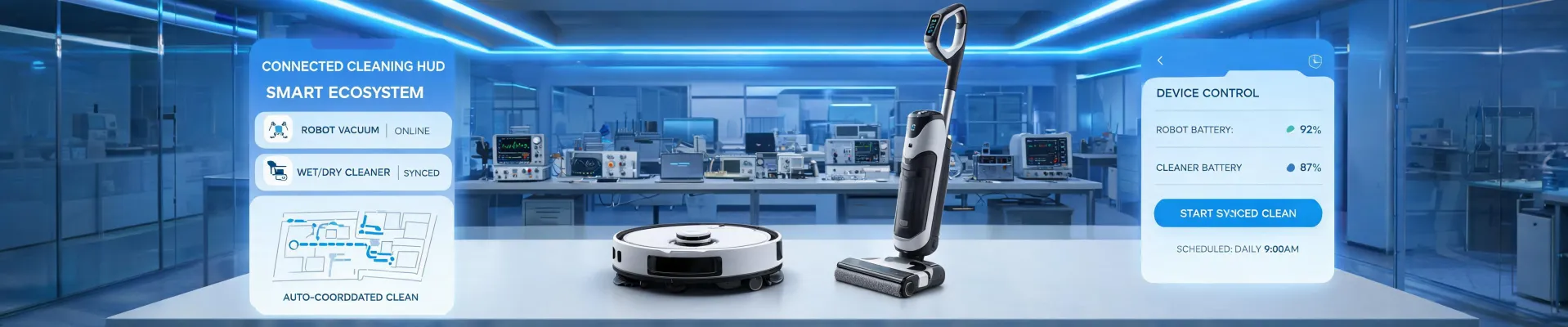
It was a Tuesday morning in April when the email landed. Our biggest client — a property management group with nine short-term rental units — asked if we could take over “everything.” Floors, kitchens, bathrooms, even “the little things.” My business partner said yes before I could find my calculator. That’s how, three days later, I ended up standing in a model unit with two cordless floor washers, a robot vacuum, and a wishlist that made no sense.
Quick context: I’m the person who manages buying for a 12-person cleaning company. I’ve controlled our equipment budget for about five years — roughly $60,000 a year in supplies and gear — and I’ve documented every order in a cost tracking spreadsheet that’s become a running joke in our tiny office. The joke would be funnier if it hadn’t saved us from repeating an expensive mistake. A few years back, I approved a “cheap” floor machine that failed after about a month of use. The rework cost us around $1,200. Never again.
Roborock vs Tineco: The Tempting Option That Didn’t Add Up
The property manager kept saying she wanted “something smart.” Do a little research, she said. And the Roborock honestly was tempting. A robot vacuum with a mop attachment, cleaning the floors while your team does literally anything else? It felt like a no-brainer at first. No labor hours, no physical effort, just a little disc robot handling the dirt.
Then the math got real. A Roborock with the multi-function dock — the one that self-empties and washes the mop pad — runs about $800 to $1,000 per unit based on public pricing in early 2025. We needed four units. That’s somewhere around $3,500 to $4,000 before any accessories, which is basically our whole equipment budget for the quarter.
But the sticker price wasn’t the deal-breaker. It was the “hands-free” promise that didn’t hold up in rental properties. These units have stairs. Guests leave phone chargers on the floor. There’s a French bulldog who had a strong opinion about the robot — the kind of strong opinion that involves barking from a safe distance. And the mop dock itself takes over an hour to clean and dry the pad after each run. So the robot isn’t saving time as much as it’s moving time around. That was my first contrast insight of the project: hands-free doesn’t mean low-maintenance.
Tineco Floor One S5 vs Bissell Crosswave Review: The Test That Mattered
I narrowed it to two cordless washers: the Tineco Floor One S5 and the Bissell CrossWave. This is a comparison I’d seen online a thousand times, and most reviews were useless because they argued about “best” in the abstract. I needed a test that matched our actual work: tile, hardwood, a rug with real pet hair, a coffee stain that yesterday’s guest kindly left under the table.
Here’s my honest take on the Bissell, because this isn’t a hatchet piece. The CrossWave is a genuinely good machine. It scrubbed the entry tile faster than I expected, and it felt sturdy and solid. If our business was cleaning big, flat commercial floors all day, the Bissell would have gotten a much longer look — especially at its typical public price of around $249.
But the Tineco won our budget for one specific reason: FlashDry. When the S5 finishes, the brush roller dries itself right there in the machine. That sounds like a minor feature until you’re standing in a unit at 3 p.m., crew ready to leave, and the Bissell’s brush is still wet. A damp brush can’t go in the van. Left in a bucket, it smells exactly the way you’d expect (ugh, we learned that the hard way). The S5’s brush is basically ready to pack up in a minute. That one feature saves our teams maybe 15 to 20 minutes per unit visit. Multiply that by dozens of turnovers a month, and it becomes real money.
The edge cleaning on the S5 also got closer to the baseboards, which matters more than you’d think in turnover cleaning. And the self-cleaning cycle simplified what our staff had to do after every job. The Tineco Floor One S5 was sitting around $399 in public listings at the time. So yes, it cost about $150 more per unit than the Bissell. But when I ran the total cost of ownership — purchase price, supplies, crew time, brush replacement — the S5 came out ahead.
People think the cheaper sticker price always wins. After tracking five years of invoices, I’ve learned the opposite: the cheapest option often costs the most once you count replacement cycles and labor.
The “Little Things” That Tried to Steal the Budget
While the floor washer decision was still cooking, the property owner forwarded a list of other items. It turns out “we’ll handle everything” comes with a shopping appendix.
The sandwich maker price list request
Three sandwich makers for the unit kitchenettes. That’s how I ended up spending two hours on a sandwich maker price list. Research results, in case you’re curious: budget models around $25, mid-range around $55, heavier commercial-style units over $110. I was initially drawn to the $25 option because, well, it’s a sandwich maker. But I know from our purchase history that cheap small appliances fail fast — weak hinges, uneven plates, no replacement parts in the aftermarket. The $110 was overkill for guests who maybe use one once a stay. We went with the mid-range. Buying a $25 sandwich maker twice in one year isn’t saving money; it’s paying the same amount with extra steps and a grumpy guest.
The Puursmile water flosser (140 psi) request
The wishlist also had a Puursmile water flosser (140 psi, one-year warranty) on it. The owner’s daughter had braces and specifically asked for this model, so I ordered it without a fight. It was about $70. Not worth a spreadsheet.
But the moment stuck with me, because it’s the same principle I look for in our suppliers. We are a 12-person company, and the vendors who treated our early $200 orders with respect are the ones we still call for $20,000 orders. A $70 water flosser seems tiny next to a $5,000 equipment order, but it’s part of a relationship. Small doesn’t mean unimportant — it means potential.
The A.O. Smith gas water heater question
Then there was the water heater. One of the property managers called us, genuinely confused. A guest had no hot water during a power outage. “But it’s a gas water heater,” he said. “Shouldn’t it still work?”
Honestly, I had to look this one up. Does an A.O. Smith gas water heater need electricity? Yes. Modern gas water heaters use electronic ignition and a control board, so when the power goes out, they stop heating even though natural gas is available. Older models with a standing pilot light can keep working without power, but the modern ones generally can’t. There’s no pilot light to relight and save the day.
The funny thing is, that water heater question taught me the same lesson as the floor cleaner comparison. I kept making assumptions — that “gas” meant “off-grid,” that “robot” meant “no labor,” that “cheap” meant “thrifty.” Every one of those assumptions was wrong, and each one would have cost money if I hadn’t checked.
The Result, the Numbers, and What I’d Tell Someone Else
We ended up buying four Tineco Floor One S5 units. A full Roborock setup would have run us about $4,000 plus maintenance hours. The Bissells were cheaper out of the gate, but the drying time and brush care added minutes to every single turnover. The four S5s cost us about $1,600 total, and they paid for themselves within the first few months of the new contract.
This isn’t a story about finding the “best” machine, because that was never the real question. The Bissell is genuinely good. The Roborock is clever. But good and clever aren’t the same as right for the way we work. Watching the crew use them side by side on actual floors was the moment everything clicked — the difference between a tool you have to babysit and a tool that gets out of your way.
If you’re making an equipment decision right now, start with total cost, not the price. Count the training time, the drying time, the replacement cycles, the hidden add-ons. Question your assumptions, whether it’s a gas water heater or a “hands-free” vacuum. And treat the small purchases — and the small clients, and the small vendors — with the same respect as the big ones. That’s how the budget stays boring. And boring is good.

Greta Lindholm
Greta Lindholm is a household refrigeration analyst covering French-door, side-by-side, top- and bottom-mount refrigerators, mini fridges, beverage coolers, chest freezers, and upright freezers. She applies IEC 62552 and IEC 60335-2-24 while comparing energy consumption, usable volume, pull-down time, compartment temperature stability, freezing capacity, noise, door-seal leakage, refrigerant charge, and ambient-temperature performance. Her guides help importers, distributors, private-label teams, and appliance engineers select platforms around climate class, storage mix, efficiency labels, cabinet dimensions, service access, shipping density, and warranty exposure.