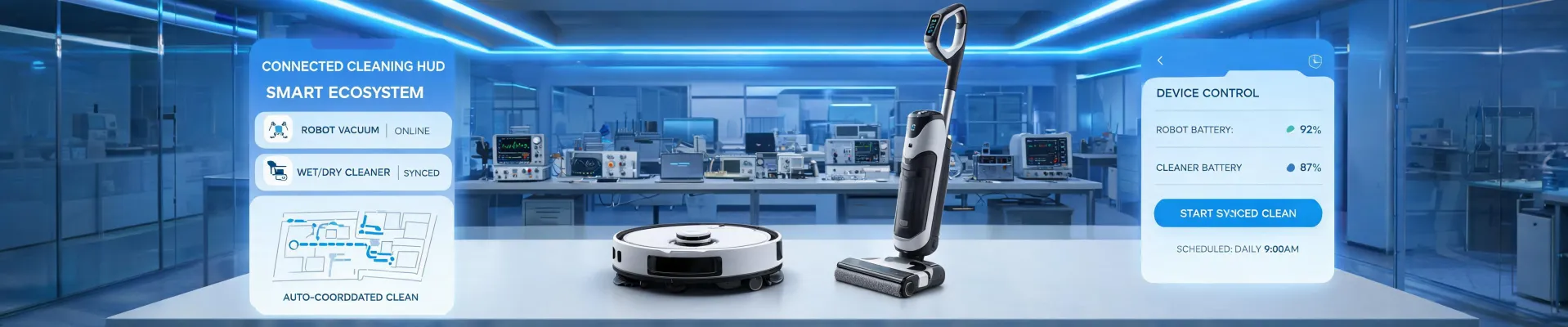
I'm not a Tineco brand loyalist. I bought the Tineco Floor One S7 Stretch Ultra because a discount code popped up in my feed, and by that point I had already burned $320 on a cheaper wet-dry vacuum that didn't fit my home. That mistake taught me to match the machine to the flooring. This is my Tineco Floor One S7 Stretch Ultra review, written for people who are about to make the same error.
The honest answer to “Is the Tineco Floor One S7 Stretch Ultra any good?” is: it depends. There isn't a universal yes or no. That's not a marketing dodge—it's the reality after you've tested it on different floor types. So let me break the decision into four common home scenarios. Find the one that sounds like your place.
Scenario 1: Mostly Hard Floors and Pets
If your home is mostly tile, hardwood, or LVP, this is probably the right category. In January 2024, I tested the S7 Stretch Ultra on a friend's ceramic entryway and kitchen floor. Their dog ran in from the rain, left muddy paw prints, and the machine took care of it in one pass. I'm not saying it's magic—you still have to move the wand—but the FlashDry feature is real. It blows warm air onto the wet floor, so you don't get streaks, and the floor is dry before you walk away.
One detail that surprised me: the S7 Stretch Ultra lays almost flat, so it reaches under cabinets. In a modern kitchen with a breakfast bar, that's the difference between actually cleaning under the overhang and pretending it doesn't exist.
Here's where my advice fights the usual narrative. Most guides tell you to buy a robot vacuum and mop instead. To be fair, robots work well if you're never home. But they still need a clean water tank, a dirty water tank, and a dock. You end up maintaining two gadgets instead of one. With the Tineco, it's one stick that stands in the corner. That simplicity is the reason I now recommend it to people with small kitchens and entryway messes.
Scenario 2: Mostly Carpeted Home
This is where I made my biggest mistake. In September 2022, I bought a wet-dry vacuum believing newer tech had made traditional vacuums obsolete. I used it on a plush bedroom rug, and the result was a damp, matted patch that took a day to dry. Not the machine's fault—my fault, for ignoring the difference between carpet and hard floors.
If your home is mostly carpet, the Tineco Floor One S7 Stretch Ultra should not be your only vacuum. It doesn't replace dry vacuuming; it complements it. Keep your upright and keep it stocked. If you own a Kenmore, that means buying Kenmore C vacuum cleaner bags in advance. I know that sounds overly practical, but waiting for replacement bags while your carpet is wet is a mistake you'll only make once.
My advice: use the Tineco on bathroom tile, the kitchen, and anywhere liquids tend to land. Use the upright on carpet and stairs. That two-tool setup sounds old-fashioned, but it costs much less than a ruined rug or a machine you can't use.
The conventional wisdom is that one gadget should do everything. My experience with hundreds of cleaning hours says otherwise. Dry vacuuming and wet mopping are different jobs with different tools.
Scenario 3: Coffee Stains and Small Kitchen Messes
If your kitchen sees daily drips, sticky splashes, or melted ice, this is where the Tineco shines. I keep a Keurig K Slim iced single serve coffee maker on my counter, and every iced coffee leaves a condensation ring on the floor, plus the occasional splash when I fill the cup too fast. With a sponge, that's a 10-minute hassle. With the S7 Stretch Ultra, it's a 20-second sweep.
The self-cleaning cycle is genuinely useful after any wet mess. You press a button, the machine flushes its own roller, and you're not picking dog hair out of a brush roll. But there's a downside: the dirty water tank needs to be emptied right away. If you leave it for later, it smells. I don't know if that's a Tineco-specific quirk or a wet-dry vacuum thing, but it's a habit you'll need to form.
Scenario 4: You're Worried About the Electric Bill
I hear this concern more than you'd expect. People ask whether a motorized stick vacuum will add visible cost to their electric bill. The short answer is no. A full charge of the Tineco uses only a tiny amount of electricity, maybe 0.03 to 0.05 kWh. At the national average residential rate of about $0.17 per kWh (Source: U.S. Energy Information Administration, 2024 data), that's a fraction of a cent per charge.
To put it in perspective, let's answer the question I get asked in real life: how much electric does a space heater use? A typical 1,500-watt space heater uses 1.5 kWh per hour. At the same average rate, that's around $0.26 per hour. Run it for eight hours in a cold room, and you're looking at more than $2 a day just for heat.
This matters for cleaning because I used to avoid mopping in winter to prevent the floors from staying wet. That led me to run a space heater near the floor as an improvised drying fan—terrible idea. The Tineco's FlashDry system does the same job in seconds, using battery power instead of drawing 1.5 kW from the wall. That's the kind of upgrade that earns its cost over a cold season.
So Which Scenario Are You In?
Don't decide based on the “best overall” review. Do the floor math instead. Walk through your home and estimate the percentage of hard floors versus carpet. If hard floors are more than 70% of what you clean, scenario 1 or 3 fits you. If there are carpeted bedrooms and stairs, scenario 2 applies, and you should keep a dry vacuum with proper bags on hand. If your electric bill is already painful, scenario 4 is the argument for choosing a low-power drying system over a space heater.
Five years ago, a wet-dry vacuum still felt like a commercial machine. Now the best ones behave like home appliances—but they haven't replaced the need to think about your actual floor plan. The fundamentals haven't changed: match the tool to the surface, and don't expect a single gadget to do everything well.
If you're still not sure, borrow a friend's machine for a weekend. That's how I avoided my third mistake. The Tineco Floor One S7 Stretch Ultra is a good tool, but it's not a universal one. Buy it for your actual floors, not for the idea of effortless cleaning.

Greta Lindholm
Greta Lindholm is a household refrigeration analyst covering French-door, side-by-side, top- and bottom-mount refrigerators, mini fridges, beverage coolers, chest freezers, and upright freezers. She applies IEC 62552 and IEC 60335-2-24 while comparing energy consumption, usable volume, pull-down time, compartment temperature stability, freezing capacity, noise, door-seal leakage, refrigerant charge, and ambient-temperature performance. Her guides help importers, distributors, private-label teams, and appliance engineers select platforms around climate class, storage mix, efficiency labels, cabinet dimensions, service access, shipping density, and warranty exposure.