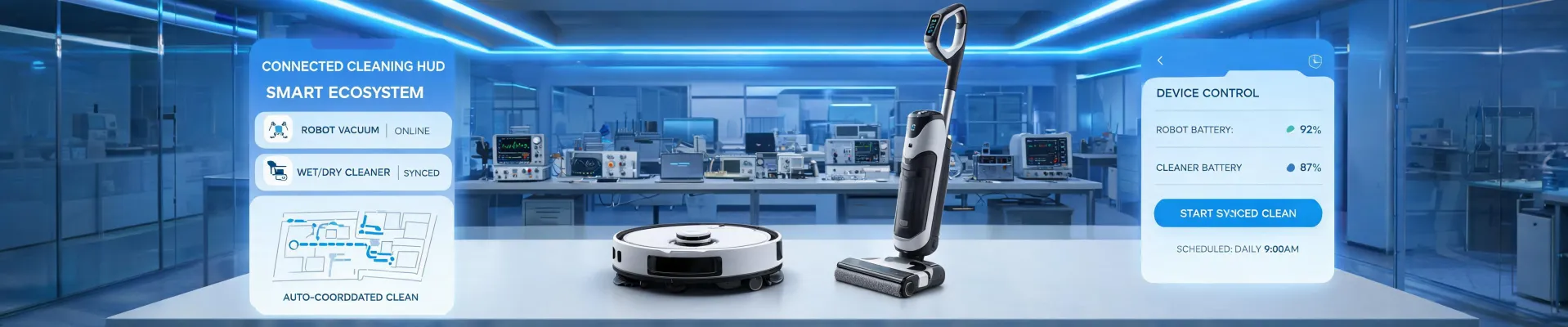
Buy the Tineco iFloor 2 if your space fits a 25-minute battery and your floors are hard surface. That's the honest, boring answer from a cost controller, not a fanboy. In Q3 2024 I bought a Tineco iFloor 2 and a Bissell CrossWave Pet Pro for our company's facilities, and I tracked the purchase price, the cleaning solution, the brush rolls, the filters, and the labor it took to keep both machines from smelling like a locker room. Fourteen months later, the verdict is clear but not dramatic: the Tineco iFloor 2 cost us about $75 a year less to own than the Bissell—and the difference was mostly labor, not the sticker price.
That $75 isn't life-changing money. But when you're the person responsible for a facilities budget, you don't need an exciting win; you need a repeatable one. This article is for others in that spot: small-business owners, property managers, or anyone buying floor-care equipment with their own P&L in mind.
Why I'm Scoring This as a Cost Controller
I'm not an appliance reviewer, and I don't get free samples. I'm a procurement manager at a ~40-person regional operations company, with roughly $180,000 a year in facilities purchases flowing through my spreadsheets. I've tracked 40+ floor-care orders since 2021, including the two machines in this article. My job also means saying "no" when a manager proposes a "really good deal." I have to show the math, and the math has to survive an audit. So I build TCO sheets the same careful way for a $200 vacuum as for a $2,000 appliance.
When I first started benchmarking wet dry vacuums, I assumed the lowest retail price would win. That assumption died in 2023, when a "cheap" floor cleaner cost us $240 in replacement rollers and filters before we retired it. Since then, I've kept a total-cost-of-ownership (TCO) sheet for every machine we bring in. The data below comes from that sheet—real receipts, real timestamps, real wages.
One more thing: I'm a small buyer. No brand shipped me a discount unit, and neither knows I'm writing this. That's actually the reason you can trust the numbers more than a sponsored review.
Bissell vs Tineco Wet Dry Vacuum: The TCO Math
Here's what I compared: the Tineco iFloor 2 (around $199 on the manufacturer's site, as of December 2024) and the Bissell CrossWave Pet Pro (around $259 at major retailers, same period). Both are wet dry vacuums—they vacuum and mop hard surfaces in one pass—and both did a credible job on dried coffee, tracked mud, and pet hair. The difference is in what it costs to keep each one running.
I kept the measurement simple: two machines, same office, same messes, alternating weeks. I didn't time every pass, but I did time maintenance. That's where budget overruns hide.
- Upfront cost: $199 for the Tineco vs. $259 for the Bissell—a $60 gap.
- Consumables: Tineco's cleaning solution is about $16 per 33-oz bottle; Bissell's is $13–15 per 64 oz. Per use, the difference is pennies. Call it a wash.
- Wear parts: The Tineco brush roll runs about $25; Bissell's about $30. Filters are comparable. Budget roughly $45–55 a year for either machine.
- Labor (the hidden one): The iFloor 2's self-cleaning cycle actually cleaned its roller. The Bissell unit's self-clean option was weaker; the roller still carried debris, so we hand-cleaned it about 10 extra minutes per month.
Do the math: 10 minutes per month is two hours per year. At a $25/hour loaded labor rate, that's about $50 a year. Add the $20/year equivalent of the upfront price gap ($60 spread over three years) and roughly $5/year in wear-part differences, and you land around $75/year in the Tineco's favor.
The counterintuitive finding isn't that Tineco won—it's that Bissell's cheaper consumables and wider retail availability didn't save it. The machine that costs $60 more upfront was more expensive to operate precisely because of a feature that many buyers dismiss as a gimmick: self-cleaning. In our use, it wasn't a gimmick. It was a labor-saving device. And labor is the line item everyone forgets to put in the spreadsheet.
Tineco iFloor 2 Review: A Cost-Buyer's Perspective
If you've been looking for a tineco ifloor2 review that doesn't sound like an infomercial, here are the specifics from our unit.
What I liked
The iFloor 2 finishes our 2,300 square feet of hard flooring in about 22 minutes on one charge. The dirt sensor (Tineco calls it iLoop) works—you can hear the suction ramp up when it rolls over a stain. And the self-cleaning cycle plus drying kept the roller genuinely clean between uses. That's not a luxury; it's what stopped us from replacing rollers twice as often. There's something satisfying about scrolling through a procurement file and watching the consumables line stay flat for six months straight.
What I disliked
The battery is integrated, not swappable. After 14 months, ours runs about 18 minutes instead of the rated 25—fine for our office, but a real risk if you're right at the edge of your square footage. There's no app, no mapping, no smart-home integration. I don't want any of that, but if you do, you're the buyer for a more expensive Tineco model, not this one.
A note for small buyers: Tineco's direct ordering never acted like we were a nuisance because we only wanted two units. When one arrived with a damaged solution tank, a replacement shipped under warranty in five days. In my experience, that kind of treatment is hit-or-miss with brands built around big-box retail. Small doesn't mean unimportant—it means potential. Today's two-unit order is tomorrow's twenty-unit order; the vendors who remember that get our repeat business.
Where Bissell Still Wins
I'm not going to tell you the Bissell CrossWave is a bad machine. It isn't. I get why a lot of popular reviews rank it so high; it's a household name and it earns its place on store shelves. There are three situations where I'd pick it over the Tineco:
1. You're already in the CrossWave ecosystem. If you own one and have a drawer full of filters, the cheapest machine you'll ever buy is the one that shares those consumables. Ecosystem switching has a real cost.
2. You regularly clean for more than 25–30 minutes straight. The Bissell's longer run time gives it an edge, and a machine that dies mid-clean costs you a second session. Honestly, for that use case neither of these is ideal; you're really shopping for a higher-end Tineco Floor One S7 or a commercial-grade unit.
3. You need replacement parts today. Bissell parts typically arrive in two days from Amazon; Tineco's direct shipping took five to seven days on one part. If downtime is more expensive than the price difference, buy the brand with the deeper aftermarket.
To be fair, the CrossWave Pet Pro is also excellent on pet hair. If you're a one-dog household or a groomer's shop, that's a meaningful point in its favor. My verdict here is a cost verdict, not a universal truth.
The Same Framework, Applied to Other Purchases
I keep this TCO habit because it saves me from myself—not just in floor-care. When one of our properties needed a 27-inch GE microwave oven combo, the cheapest quote died on installation fees, and the mid-priced quote won. When a range hood repair in Nashville, TN came back at $450, I compared repair against replacement and fixed it for $180 with parts only. Even a small personal purchase taught the same lesson: my $35 "bargain" massage gun made my skin itch after every use because of a cheap rubber head, so I returned it and paid $60 for one with silicone. Same failure at every scale—the number on the tag is not the price.
Before You Buy
Prices change. The figures above were accurate for the models I purchased, as of December 2024 and January 2025. Verify current pricing on tineco.com or at your retailer before you commit.
And note the boundaries of my verdict: the Tineco iFloor 2 is the right call for small spaces, small teams, and smaller budgets. If your floor plan is bigger than about 2,300 square feet of hard surface, if you have wall-to-wall carpet, or if cleaning is a daily commercial operation rather than a task between clients—this isn't your machine. Neither is the Bissell CrossWave. That honesty is the only reason a cost controller's opinion is worth reading.

Greta Lindholm
Greta Lindholm is a household refrigeration analyst covering French-door, side-by-side, top- and bottom-mount refrigerators, mini fridges, beverage coolers, chest freezers, and upright freezers. She applies IEC 62552 and IEC 60335-2-24 while comparing energy consumption, usable volume, pull-down time, compartment temperature stability, freezing capacity, noise, door-seal leakage, refrigerant charge, and ambient-temperature performance. Her guides help importers, distributors, private-label teams, and appliance engineers select platforms around climate class, storage mix, efficiency labels, cabinet dimensions, service access, shipping density, and warranty exposure.